Groundhog Handwritten Font for Crafters & Sellers
If you’ve ever spent hours tweaking letter spacing on a candle label—only to find the script looks stiff, overly ornate, or worse, unreadable at 12pt—you know how much weight the right font carries in handmade product design. Groundhog isn’t just another script font. It’s a thoughtful, grounded handwritten brush typeface that balances personality with practicality—and it’s quickly become my go-to for physical products I sell on Etsy and craft fairs.
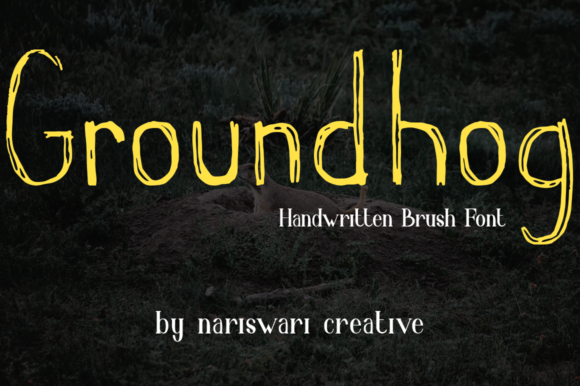
What makes Groundhog stand out is its quiet confidence: soft but not fragile, expressive but never fussy. The strokes have gentle tapering and subtle texture—like ink pulled across paper with a fine brush—not the heavy drama of calligraphic scripts or the pixelated thinness of some digital handwriting fonts. It feels intentional, human, and quietly refined. That’s why it works so well for customers who value authenticity: whether they’re buying a linen tea towel, a minimalist wedding invite suite, or a small-batch soap label, Groundhog helps your product feel both handcrafted and professionally designed.
I use Groundhog across a wide range of tangible items—no digital-only fluff here. For candle and skincare labels, I set it at 14–18pt in all-caps for scent names like “Honey Lavender” or “Smoke & Cedar.” Its clean baseline and open counters mean it cuts cleanly on Cricut Explore and Silhouette Cameo machines—even on matte vinyl under 1” tall. On greeting cards and invitations, I pair Groundhog with a crisp sans serif (think Montserrat Light or Inter Regular) for body text: the contrast gives warmth to headlines while keeping readability intact. And for farmhouse-style wall art or boutique gift tags? A single line in Groundhog, centered over raw wood or kraft cardstock, says “thoughtful” without saying a word.
It shines especially well in seasonal and celebratory contexts. Last December, I used Groundhog for holiday product packaging—think cinnamon roll mix jars, hot cocoa sachets, and mini ornament tags. Its even rhythm and consistent x-height meant every label looked cohesive across five different SKUs. For weddings, I’ve built full invitation suites around it: “Emma & James” in Groundhog, followed by date, venue, and RSVP details in a neutral serif. Guests consistently comment on how “warm” and “inviting” the typography feels—proof that typeface choice directly shapes emotional response.
Readability matters most when scale shifts. Groundhog performs reliably down to 10pt on printed planner inserts and up to 120pt on large-format signs—but avoid using it for dense paragraphs or fine print. It’s a display font, first and foremost. Think titles, names, short phrases, and decorative accents—not body copy. That said, its generous letter spacing and clear character shapes make it far more legible than many script fonts at small sizes, especially on textured papers or fabric transfers.
Pairing is intuitive. Since Groundhog lives in the Script Amp category—a space where expressive handwriting meets commercial usability—I almost always anchor it with something structured. A light sans serif for contrast (like Lato or Poppins), a warm serif for vintage charm (Cormorant Garamond), or even a subtle monospace for modern contrast (JetBrains Mono Light). What I *don’t* do is pair it with another script—too much motion cancels out clarity. And because Groundhog is a handwritten font built for real-world making, it includes standard OpenType features: basic ligatures, stylistic alternates, and multilingual support covering Western European languages—enough to handle French accents on apothecary labels or German umlauts on artisanal chocolate wrappers without swapping fonts mid-design.
File-wise, it comes in OTF and TTF formats—fully compatible with Adobe Creative Suite, Canva Pro, Cricut Design Space, and Silhouette Studio. No web font files, and no need for them: this is a fonts product made for physical output and downloadable printables, not website headers. That focus keeps it lean, reliable, and production-ready.
Licensing is straightforward—and critical if you’re selling. Groundhog includes an extended commercial license, meaning you can use it to create and sell physical products (stickers, mugs, tote bags), digital downloads (planner pages, SVG cut files, printable wall art), templates (Canva, PowerPoint), client work (logo lockups, shop signage), and even merchandise (t-shirts, enamel pins). Just keep in mind: you may not resell the font file itself, embed it in unsecured apps, or claim it as your own design. As a small shop owner, that clarity saves me time, legal worry, and revision rounds with clients.
Real-world examples that work: a “Freshly Baked” header on bakery box stickers; “Est. 2019” stamped beside a logo on a ceramic mug; “Welcome Home” on a reclaimed wood welcome sign; “Hand-Poured Soy Wax” on a candle jar label; “Thank You” on a kraft thank-you card tucked inside a subscription box. In each case, Groundhog adds sincerity without sacrificing polish.
It’s also helped me tighten my brand identity. Before switching to Groundhog, I cycled through three different script fonts trying to land on “just right.” Now, whether I’m designing a new product label, updating my Instagram story template, or mocking up a seasonal collection on Placeit, I know exactly which font will hold the line between handmade charm and professional cohesion. That consistency builds recognition—customers start to associate that gentle, confident handwriting with quality, care, and attention to detail.
If you’re choosing a premium font for your next batch of physical goods or digital printables, ask yourself: does it look good at 8mm tall on a sticker? Does it stay legible when printed on uncoated paper? Does it pair easily with a workhorse companion font? Does it come with clear commercial rights—and enough language support for your market? Groundhog answers yes to all four. It’s not flashy. It doesn’t try to be everything. But for crafters who build businesses one carefully designed label, tag, card, or sign at a time—it’s exactly what you’ve been reaching for.